
Synopsis
Compound overview
- Research only
- In clinical trials
- Approved outside US
- FDA-approved
What it is
Toremifene (Fareston) is a selective estrogen receptor modulator (SERM), closely related to tamoxifen. It is an FDA-approved prescription medicine used to treat advanced breast cancer in some patients.
What it does
Documented and off-label uses include:
- Treats hormone-receptor-positive metastatic breast cancer
- Blocks estrogen's effect in breast tissue
- Sometimes used off the research scene to manage estrogen effects
- Has documented clinical data
How it works
Toremifene blocks estrogen receptors in breast tissue, cutting off the hormone signal that estrogen-sensitive cancer cells rely on to grow.
Safety notes
Toremifene is a prescription cancer medicine. It can affect heart rhythm (a QT-interval prolongation warning) and, like other SERMs, raises the risk of blood clots. It should only be used under medical supervision; research-vendor material is not pharmacy-grade.
Where to buy Toremifene Citrate
Standard lyophilized vial — reconstitute and measure doses yourself. The conventional research format.
Affiliate links — we may earn a commission at no extra cost to you.
Molecular Structure
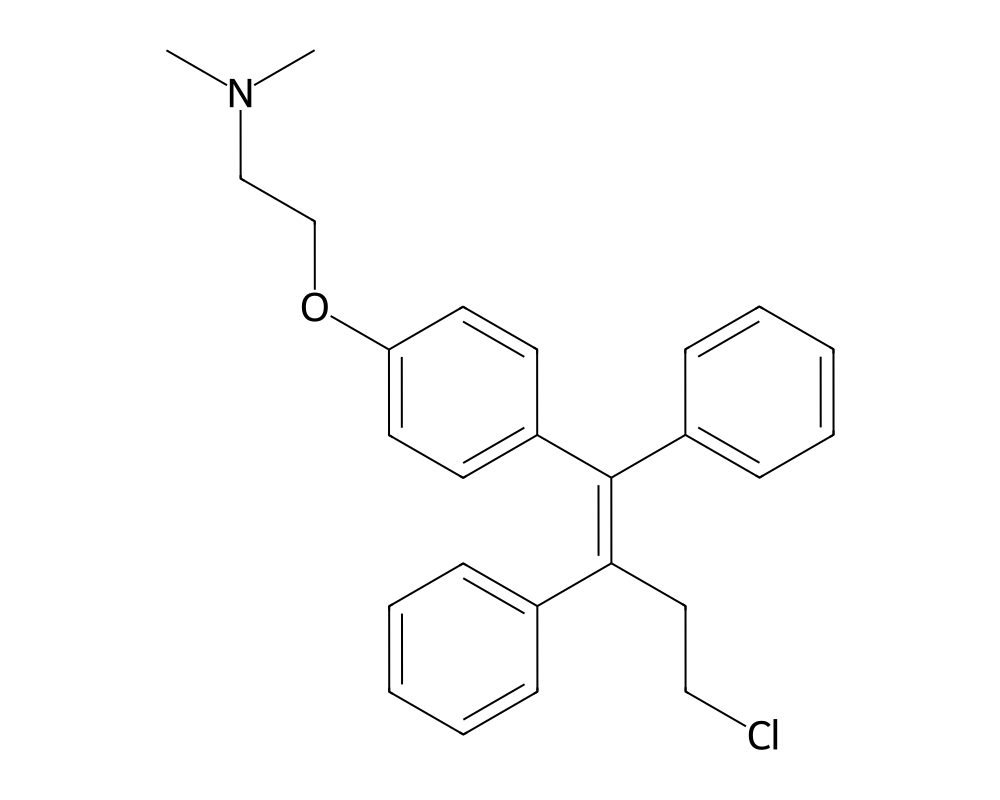
Toremifene citrate is a second-generation selective estrogen receptor modulator (SERM) belonging to the triphenylethylene chemical class, structurally related to tamoxifen but differentiated by a single chlorine atom substitution. Developed by Orion Corporation and marketed under the brand name Fareston, it received FDA approval in 1997 for the treatment of metastatic breast cancer in postmenopausal women with estrogen receptor-positive or estrogen receptor-unknown tumors.
Contents
- Mechanism of Action
- Estrogen Receptor Binding
- Tissue-Selective Activity
- Anti-Androgen Effects
- Pharmacokinetics
- Research Summary
- Breast Cancer Treatment
- Bone Health
- Prostate Cancer Prevention
- Comparative Safety Profile
- Dosing in Published Research
- Safety and Side Effects
- Current Research Status
- Frequently Asked Questions
The chlorine substitution at position 4 of the ethyl side chain confers a distinct pharmacological profile compared to tamoxifen. Preclinical studies have suggested that toremifene may carry a lower risk of endometrial stimulation and hepatocarcinogenicity, though clinical evidence on these differences remains subject to ongoing evaluation. Toremifene has also been investigated for bone health, prostate cancer, and as an adjunctive compound in hormonal recovery protocols.
Mechanism of Action
Estrogen Receptor Binding
Toremifene competes with estradiol for binding at both estrogen receptor alpha (ERa) and estrogen receptor beta (ERb). Upon binding, toremifene induces a conformational change in the receptor that differs from the change induced by estradiol. This altered conformation affects which coactivator and corepressor proteins are recruited to the ligand-receptor complex, producing tissue-specific agonist or antagonist effects.
Tissue-Selective Activity
In breast tissue, toremifene functions as a potent estrogen antagonist, blocking estradiol-driven transcription of genes involved in cell proliferation, including cyclin D1 and c-Myc. This antiproliferative effect underlies its use in breast cancer treatment. In bone tissue, toremifene exhibits partial estrogen agonist activity, helping to maintain bone mineral density by modulating osteoclast function. In the uterus, toremifene shows minimal agonist activity compared to tamoxifen, which has been associated with its potentially lower risk of endometrial hyperplasia.
Anti-Androgen Effects
Research has identified an additional mechanism relevant to prostate cancer: toremifene modulates androgen receptor signaling through indirect pathways. By altering the estrogen-to-androgen balance in prostate tissue and reducing the conversion of testosterone to dihydrotestosterone (DHT), toremifene has been explored as an adjunctive agent in prostate cancer management, particularly for the prevention of high-grade prostatic intraepithelial neoplasia (PIN) progression.
Pharmacokinetics
Toremifene is well absorbed after oral administration, reaching peak plasma concentrations within 3 hours. It undergoes extensive hepatic metabolism via CYP3A4 to its primary metabolite, N-desmethyltoremifene, which also has antiestrogenic activity. The terminal elimination half-life is approximately 5 days, supporting once-daily dosing. Steady-state plasma concentrations are achieved within 4 to 6 weeks of daily administration.
Research Summary
Breast Cancer Treatment
The pivotal Phase III trial comparing toremifene 60 mg daily to tamoxifen 20 mg daily in postmenopausal women with advanced breast cancer demonstrated equivalent efficacy. Both compounds produced similar objective response rates (approximately 21% vs. 19%) and similar time to progression (5.6 vs. 5.8 months). This noninferiority evidence supported FDA approval and established toremifene as an alternative first-line endocrine therapy.
Bone Health
The TOPS (Toremifene and Osteoporosis Prevention Study) trial evaluated toremifene’s effects on bone mineral density in postmenopausal women. Over 5 years, toremifene preserved lumbar spine bone density compared to placebo, with a net difference of approximately 2.8%. Femoral neck bone density was also maintained. These skeletal-protective effects are attributed to toremifene’s partial estrogen agonist activity in bone tissue.
Prostate Cancer Prevention
A Phase III trial (NCT00090766) evaluated toremifene 20 mg daily for prevention of prostate cancer in men with high-grade PIN. While the primary endpoint of prostate cancer incidence reduction was not met, the study revealed significant reductions in new cases of high-grade PIN and improvements in lipid profiles. The trial enrolled over 1,500 men and provided extensive safety data for toremifene in male patients.
Comparative Safety Profile
A pooled analysis of clinical trial data by Holli et al. (2000) compared the safety profiles of toremifene and tamoxifen across multiple randomized trials. Toremifene was associated with a numerically lower incidence of endometrial changes, though this difference did not reach statistical significance in any individual trial. Both compounds showed similar rates of hot flashes, nausea, and thromboembolic events. Toremifene produced less elevation of liver enzymes and triglycerides compared to tamoxifen in some analyses.
Dosing in Published Research
About this section
The information below reports dosing only as it appears in published clinical or preclinical research and official regulatory documents. It is provided as published-literature reference material. It is not dosing guidance, not medical advice, and not a recommendation to use or self-administer this compound.
Toremifene citrate is an FDA-approved prescription medicine, sold as Fareston. According to the FDA-approved labeling, the dose is 60 mg taken once daily by mouth, for metastatic breast cancer in postmenopausal women with estrogen-receptor-positive or unknown tumor status. These figures are drawn from FDA-approved prescribing information.
Important
Toremifene carries an FDA Boxed Warning for dose-dependent prolongation of the QT interval, which can lead to a serious abnormal heart rhythm. The labeled dose applies to the approved prescription product used under the supervision of an oncologist or physician; it is not a recommendation and does not apply to material sold for research use.
Safety and Side Effects
The most commonly reported adverse effects of toremifene in clinical trials include hot flashes (reported in approximately 35% of patients), sweating, nausea, and vaginal discharge. These effects reflect the compound’s interaction with estrogen receptors and are consistent across the SERM drug class.
Toremifene carries a QT prolongation warning based on electrocardiographic data showing dose-dependent increases in the QTcF interval. At the standard 60 mg dose, the mean QTc prolongation was approximately 7 milliseconds, increasing to 21 milliseconds at 300 mg. This effect is attributed to inhibition of the hERG potassium channel and should be considered in patients with pre-existing cardiac conditions or those taking other QT-prolonging medications.
Unlike tamoxifen, toremifene does not form DNA adducts in preclinical models, which has been cited as a theoretical safety advantage. Tamoxifen’s metabolite alpha-hydroxytamoxifen can form DNA adducts in endometrial tissue, a mechanism linked to the elevated endometrial cancer risk observed with long-term tamoxifen use. The absence of this metabolic pathway with toremifene suggests a potentially more favorable long-term safety profile, though clinical confirmation of this difference requires additional long-term studies.
Current Research Status
Toremifene is FDA-approved and commercially available for metastatic breast cancer treatment. It holds additional regulatory approvals in multiple countries for early-stage breast cancer indications. Current research directions include evaluation as a bone-protective agent in men receiving androgen deprivation therapy for prostate cancer, investigation in combination with CDK4/6 inhibitors for breast cancer, and study of its potential neuroprotective effects in preclinical models of Alzheimer’s disease, where its ability to modulate cholesterol metabolism in the brain has generated interest.
Frequently Asked Questions
What is toremifene citrate?
Toremifene, brand name Fareston, is a selective estrogen receptor modulator (SERM) closely related to tamoxifen. It is an FDA-approved prescription medicine used to treat advanced hormone-receptor-positive breast cancer in certain patients.
How does toremifene work?
Toremifene competes with estradiol for binding at estrogen receptors. When it binds, it induces a receptor conformation that differs from estrogen’s, which blocks estrogen’s effect in breast tissue.
Is toremifene FDA-approved?
Yes. Toremifene is FDA-approved and commercially available for metastatic breast cancer treatment, and it holds additional approvals in several countries for early-stage breast cancer indications.
What does the research say about toremifene?
The pivotal Phase III trial comparing toremifene 60 mg daily with tamoxifen 20 mg daily in postmenopausal women with advanced breast cancer found equivalent efficacy, with similar objective response rates. Research has also examined it as a bone-protective agent in men receiving androgen deprivation therapy.
What are the safety concerns with toremifene?
The most commonly reported adverse effects in clinical trials include hot flashes, reported in roughly 35% of patients, along with sweating, nausea and vaginal discharge. These reflect the compound’s interaction with estrogen receptors and are consistent across the SERM class.
Research Handling & Storage
Storage
- Unopened: Store at controlled room temperature, 20–25°C (68–77°F), away from direct sunlight, heat, and moisture.
- Opened: Keep container tightly closed. Use within the timeframe indicated on the label, typically 30–90 days after opening.
- Do not freeze liquid solutions unless specifically indicated.
Handling Precautions
- Handle with appropriate personal protective equipment (PPE) including nitrile gloves, lab coat, and eye protection.
- Use aseptic/sterile technique when reconstituting and transferring solutions to prevent contamination.
- Avoid repeated freeze-thaw cycles which may denature the compound and reduce potency.
- Keep detailed laboratory records including reconstitution dates, lot numbers, concentrations, and storage conditions.
- Dispose of unused material and sharps in accordance with local regulations and institutional biosafety guidelines.
Stability & Shelf Life
Liquid formulations typically remain stable for 1–2 years when stored at the recommended temperature in the original sealed container. Once opened, potency may gradually decrease. Monitor for any changes in color, clarity, or odor, which may indicate degradation.
Purity & Quality Considerations
Research-grade compounds should be accompanied by a Certificate of Analysis (COA) confirming purity, typically verified by High-Performance Liquid Chromatography (HPLC) and Mass Spectrometry (MS). Look for purity levels of ≥98% for research applications. Third-party testing adds an additional layer of quality assurance. Always verify the source and documentation before using any research compound.
Research Supplies & Resources
Essential supplies and educational resources for peptide research. Links go to Amazon.com.
Lab Supplies
Recommended Reading
Lab Equipment
As an Amazon Associate, peptides.fyi earns from qualifying purchases. Learn more.
