
Synopsis
Compound overview
- Research only
- In clinical trials
- Approved outside US
- FDA-approved
What it is
Dutasteride is a 5-alpha-reductase inhibitor. It is an FDA-approved prescription medicine, sold as Avodart to treat benign prostate enlargement.
What it does
Documented and off-label uses include:
- Treats benign prostate enlargement
- Used off-label for male-pattern hair loss
- Lowers the hormone DHT throughout the body
- Longer-acting than the similar drug finasteride
How it works
Dutasteride blocks the enzyme that converts testosterone into DHT, a more potent androgen involved in prostate growth and hair loss. It blocks both forms of the enzyme, lowering DHT more than finasteride.
Safety notes
Dutasteride is prescription-only. It can cause sexual side effects, and a small number of users report effects that persist after stopping. It must not be handled by or used in pregnancy, as it can harm a developing baby. Research-vendor material is not pharmacy-grade.
Where to buy Dutasteride
Standard lyophilized vial — reconstitute and measure doses yourself. The conventional research format.
Affiliate links — we may earn a commission at no extra cost to you.
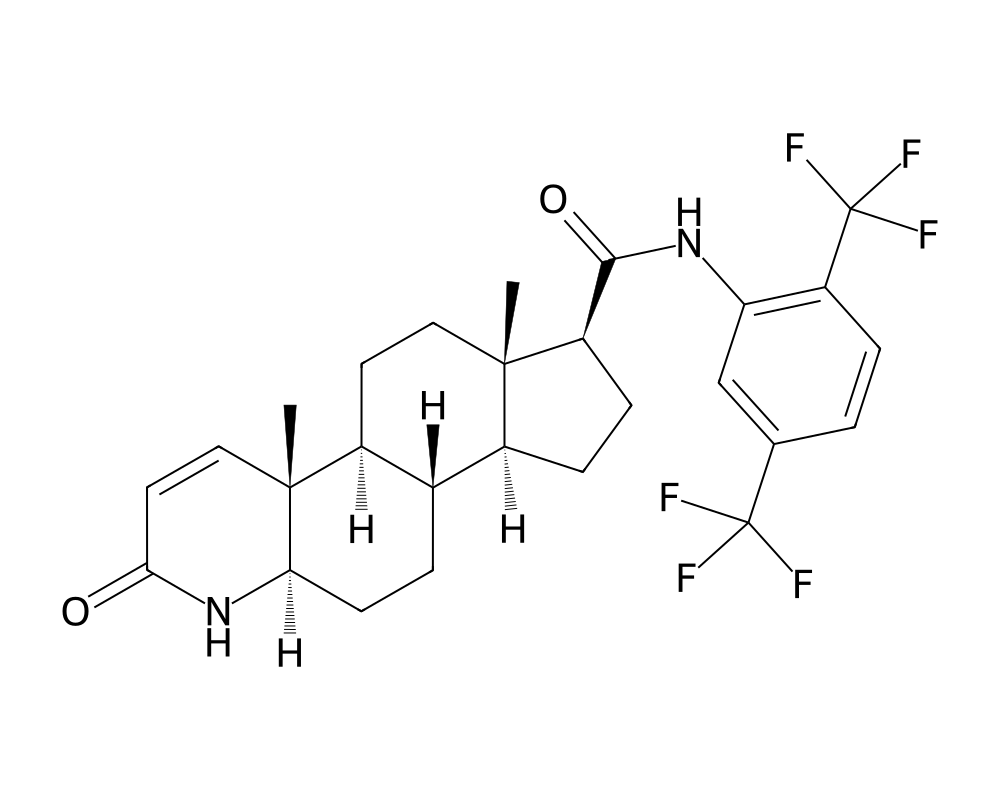
Molecular Structure
Overview
Dutasteride is a synthetic 4-azasteroid compound that functions as a dual inhibitor of both type I and type II isoforms of the enzyme 5-alpha reductase, which converts testosterone to dihydrotestosterone (DHT). Developed by GlaxoSmithKline and marketed under the brand name Avodart, dutasteride was approved by the FDA in 2001 for the treatment of symptomatic benign prostatic hyperplasia (BPH) in men with an enlarged prostate.
Contents
- Overview
- Mechanism of Action
- 5-Alpha Reductase Isoforms
- DHT Suppression and Prostatic Effects
- Hormonal Consequences
- Research Summary
- Phase III BPH Trials
- REDUCE Trial (Prostate Cancer Prevention)
- CombAT Study
- Dosing in Published Research
- Safety and Side Effects
- Current Research Status
- Frequently Asked Questions
The distinction between dutasteride and its predecessor finasteride lies primarily in their selectivity profiles. Finasteride predominantly inhibits the type II isoform of 5-alpha reductase, which is concentrated in the prostate, seminal vesicles, and hair follicles. Dutasteride, by contrast, inhibits both type I (expressed in skin, liver, and sebaceous glands) and type II isoforms, resulting in more comprehensive suppression of DHT production. While finasteride reduces serum DHT levels by approximately 70%, dutasteride achieves suppression of greater than 90%, making it the more potent of the two approved 5-alpha reductase inhibitors.
Dutasteride has an extraordinarily long terminal elimination half-life of approximately 5 weeks at steady state, a consequence of its high lipophilicity and extensive distribution into tissues. This prolonged half-life means that the drug accumulates slowly and that its pharmacological effects persist for months after discontinuation, a factor with important clinical implications for both efficacy and the management of adverse effects.
Mechanism of Action
Dutasteride exerts its therapeutic effects through competitive and specific inhibition of both type I and type II 5-alpha reductase isoenzymes. These enzymes catalyze the NADPH-dependent reduction of the delta-4,5 double bond of testosterone, converting it to the more potent androgen 5-alpha-dihydrotestosterone (DHT).
5-Alpha Reductase Isoforms
Type I 5-alpha reductase (encoded by the SRD5A1 gene) is widely expressed in skin (particularly sebaceous glands), liver, and some brain regions. It operates optimally at a neutral to alkaline pH and is responsible for a significant proportion of circulating DHT. Type II 5-alpha reductase (encoded by SRD5A2) is predominantly expressed in the prostate, seminal vesicles, epididymis, and hair follicles, functioning optimally at acidic pH. By inhibiting both isoforms, dutasteride produces more complete suppression of DHT synthesis than selective type II inhibitors.
DHT Suppression and Prostatic Effects
In the prostate, DHT is the primary androgenic stimulus driving epithelial and stromal growth. DHT binds to the androgen receptor with approximately 2-5-fold greater affinity than testosterone and has a slower dissociation rate, making it a more potent activator of androgen-responsive gene transcription. By reducing intraprostatic DHT concentrations by approximately 94-97%, dutasteride induces prostatic epithelial apoptosis and stromal involution, resulting in measurable prostate volume reduction of 20-25% over 6-12 months of therapy. This reduction in prostate size translates to improved urinary flow rates and reduced lower urinary tract symptoms.
Hormonal Consequences
The near-complete suppression of DHT by dutasteride triggers a compensatory increase in serum testosterone levels of approximately 10-20% through reduced negative feedback on the hypothalamic-pituitary-gonadal axis. Serum estradiol levels may also increase modestly due to the diversion of testosterone toward aromatization rather than 5-alpha reduction. These hormonal shifts are generally clinically insignificant in most patients but represent important physiological consequences of comprehensive 5-alpha reductase inhibition.
Research Summary
Phase III BPH Trials
Clark et al. (2004) published results from the pivotal Phase III trials evaluating dutasteride for BPH in The Journal of Urology. These were three identical two-year, randomized, double-blind, placebo-controlled trials (ARIA studies) enrolling a total of 4,325 men with moderate to severe BPH symptoms. Dutasteride 0.5 mg daily produced a 25.7% reduction in prostate volume at 24 months compared to a 0.5% increase with placebo (p<0.001). Maximum urinary flow rate improved by 2.2 mL/s with dutasteride versus 0.6 mL/s with placebo, and symptom scores improved by 4.5 points versus 2.3 points. The risk of acute urinary retention was reduced by 57% and the risk of BPH-related surgery by 48%.
REDUCE Trial (Prostate Cancer Prevention)
Andriole et al. (2010) reported results from the Reduction by Dutasteride of Prostate Cancer Events (REDUCE) trial in the New England Journal of Medicine. This landmark study randomized 8,231 men with elevated PSA levels (2.5-10 ng/mL) and a prior negative prostate biopsy to dutasteride 0.5 mg daily or placebo for 4 years, with protocol-mandated prostate biopsies at 2 and 4 years. Dutasteride reduced the relative risk of biopsy-detectable prostate cancer by 22.8% (659 cancers in the dutasteride group vs. 858 in the placebo group, p<0.001). However, the trial also noted a numerically higher incidence of Gleason score 8-10 tumors in the dutasteride group (12 vs. 1), generating significant debate about the safety implications that ultimately prevented FDA approval for this chemoprevention indication.
CombAT Study
The Combination of Avodart and Tamsulosin (CombAT) study demonstrated that combination therapy with dutasteride plus the alpha-blocker tamsulosin was superior to either monotherapy for reducing BPH progression, symptom improvement, and the risk of acute urinary retention and BPH-related surgery over 4 years of treatment.
Dosing in Published Research
About this section
The information below reports dosing only as it appears in published clinical or preclinical research and official regulatory documents. It is provided as published-literature reference material. It is not dosing guidance, not medical advice, and not a recommendation to use or self-administer this compound.
Dutasteride is an FDA-approved prescription medicine, sold as Avodart. According to the FDA-approved labeling, the dose for symptomatic benign prostatic hyperplasia is one 0.5 mg capsule taken once daily, used alone or in combination with the alpha-blocker tamsulosin. A treatment period of at least 6 months is generally needed to assess response. These figures are drawn from FDA-approved prescribing information.
Important
Dutasteride lowers serum PSA and should not be handled by women who are or may become pregnant, because of a risk to a male fetus. The labeled dose applies to the approved prescription product used under medical supervision; it is not a recommendation and does not apply to material sold for research use.
Safety and Side Effects
Dutasteride is an FDA-approved drug with a characterized safety profile. Its most common adverse effects are sexual: decreased libido, erectile dysfunction, ejaculation disorders, and gynecomastia, meaning breast enlargement or tenderness. Some men report that sexual side effects, and mood symptoms including depressed mood, persist after the drug is stopped, although the frequency and mechanism of persistent effects remain debated. Dutasteride lowers serum prostate-specific antigen (PSA), which must be accounted for in prostate cancer screening, and analyses of 5-alpha-reductase inhibitors have noted an association with a higher incidence of high-grade prostate cancer. Dutasteride is absorbed through the skin and is a known teratogen: it can cause abnormalities of the genitalia in a male fetus, so the capsules should not be handled by women who are or may become pregnant, and treated men should not donate blood until an appropriate interval after stopping.
Current Research Status
Dutasteride is an FDA-approved prescription medication, marketed as Avodart, approved for the treatment of symptomatic benign prostatic hyperplasia, alone or in combination with tamsulosin. Its use for scalp hair loss is off-label; the related drug finasteride is approved for that use at a specific dose, but dutasteride is not. As a prescription drug it should be used under medical supervision.
Frequently Asked Questions
What is dutasteride?
Dutasteride is a dual 5-alpha-reductase inhibitor. It is an FDA-approved prescription medicine, sold as Avodart, used to treat benign prostatic hyperplasia, the non-cancerous enlargement of the prostate.
How does dutasteride work?
Dutasteride inhibits both type I and type II forms of 5-alpha reductase, the enzyme that converts testosterone into the more potent androgen DHT. By lowering DHT throughout the body, it reduces the androgen signalling involved in prostate growth.
Is dutasteride FDA-approved?
Yes. Dutasteride is FDA-approved for symptomatic benign prostatic hyperplasia, alone or in combination with tamsulosin. Its use for scalp hair loss is off-label; the related drug finasteride is approved for that use.
What does the research say about dutasteride?
The pivotal Phase III ARIA trials reported by Clark and colleagues (2004), three two-year placebo-controlled studies enrolling 4,325 men, established dutasteride’s efficacy for benign prostatic hyperplasia. It is longer-acting than the similar drug finasteride.
What are the safety concerns with dutasteride?
The most common adverse effects are sexual: decreased libido, erectile dysfunction, ejaculation disorders and gynecomastia (breast enlargement or tenderness). Some men report that sexual and mood symptoms can persist, and it must not be handled by pregnant women.
Research Handling & Storage
Storage
- Unopened: Store at controlled room temperature, 20–25°C (68–77°F), away from direct sunlight, heat, and moisture.
- Opened: Keep container tightly closed. Use within the timeframe indicated on the label, typically 30–90 days after opening.
- Do not freeze liquid solutions unless specifically indicated.
Handling Precautions
- Handle with appropriate personal protective equipment (PPE) including nitrile gloves, lab coat, and eye protection.
- Use aseptic/sterile technique when reconstituting and transferring solutions to prevent contamination.
- Avoid repeated freeze-thaw cycles which may denature the compound and reduce potency.
- Keep detailed laboratory records including reconstitution dates, lot numbers, concentrations, and storage conditions.
- Dispose of unused material and sharps in accordance with local regulations and institutional biosafety guidelines.
Stability & Shelf Life
Liquid formulations typically remain stable for 1–2 years when stored at the recommended temperature in the original sealed container. Once opened, potency may gradually decrease. Monitor for any changes in color, clarity, or odor, which may indicate degradation.
Purity & Quality Considerations
Research-grade compounds should be accompanied by a Certificate of Analysis (COA) confirming purity, typically verified by High-Performance Liquid Chromatography (HPLC) and Mass Spectrometry (MS). Look for purity levels of ≥98% for research applications. Third-party testing adds an additional layer of quality assurance. Always verify the source and documentation before using any research compound.
Research Supplies & Resources
Essential supplies and educational resources for peptide research. Links go to Amazon.com.
Lab Supplies
Recommended Reading
Lab Equipment
As an Amazon Associate, peptides.fyi earns from qualifying purchases. Learn more.
