
Synopsis
Compound overview
- Research only
- In clinical trials
- Approved outside US
- FDA-approved
What it is
Tadalafil is a PDE5 inhibitor. It is an FDA-approved prescription medicine, sold as Cialis for erectile dysfunction and as Adcirca for a lung blood-pressure condition.
What it does
Documented clinical uses include:
- Treats erectile dysfunction
- Treats benign prostate enlargement symptoms
- Treats pulmonary arterial hypertension
- Longer-acting than similar ED drugs
How it works
Tadalafil blocks PDE5, an enzyme that breaks down a molecule (cGMP) responsible for relaxing blood vessels. With PDE5 blocked, blood vessels stay relaxed longer, improving blood flow.
Safety notes
Tadalafil is prescription-only. It must never be combined with nitrate heart medicines, as the combination can cause a dangerous drop in blood pressure. Side effects include headache, flushing and back pain. Research-vendor material is not pharmacy-grade and should not be used without medical advice.
Where to buy Tadalafil
Standard lyophilized vial — reconstitute and measure doses yourself. The conventional research format.
Affiliate links — we may earn a commission at no extra cost to you.
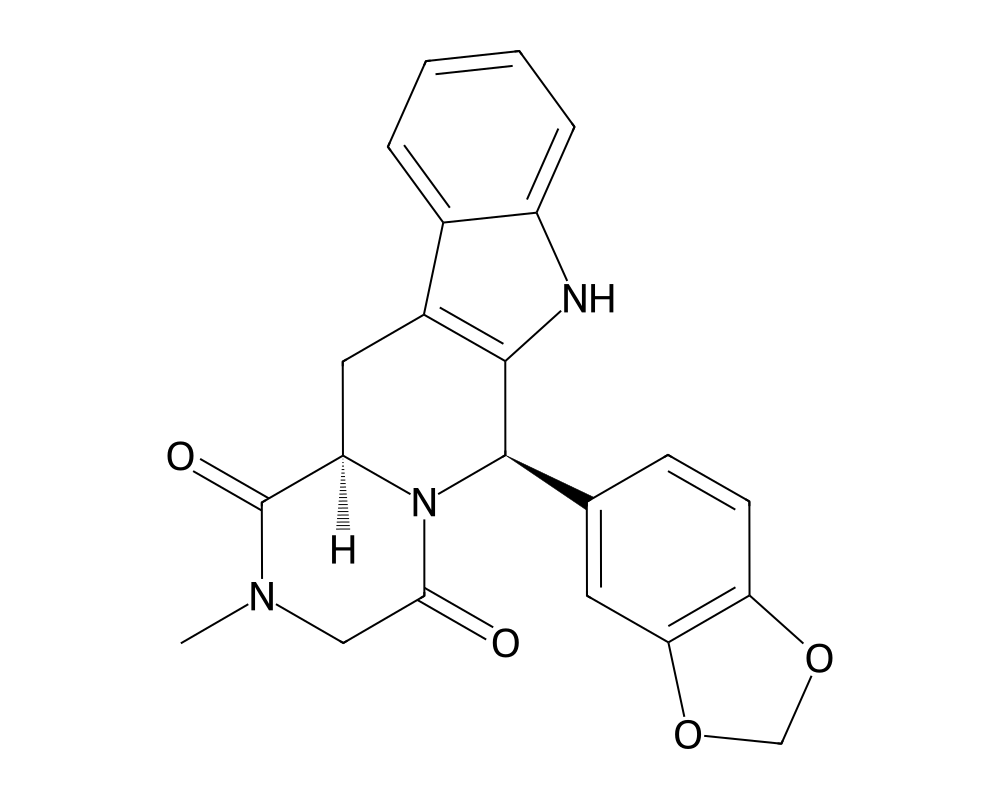
Molecular Structure
Overview
Tadalafil is a potent and selective inhibitor of phosphodiesterase type 5 (PDE5), originally developed through a collaboration between ICOS Corporation and Eli Lilly. It was approved by the FDA in November 2003 under the brand name Cialis for the treatment of erectile dysfunction (ED) and has since received additional approvals for benign prostatic hyperplasia (BPH) in 2011 and pulmonary arterial hypertension (PAH) in 2009 under the brand name Adcirca.
Contents
Tadalafil is distinguished from other PDE5 inhibitors (sildenafil, vardenafil, avanafil) primarily by its extended duration of action. With a terminal elimination half-life of approximately 17.5 hours, tadalafil provides a therapeutic window of up to 36 hours following a single dose, earning it the colloquial designation as the “weekend pill.” This pharmacokinetic advantage also enables a unique daily low-dose regimen (2.5-5 mg) that maintains continuous PDE5 inhibition, providing on-demand readiness without the need to time dosing around sexual activity.
Structurally, tadalafil is a pyrazino[1′,2′:1,6]pyrido[3,4-b]indole-1,4-dione derivative, making it chemically distinct from the pyrazolopyrimidinone-based sildenafil and the imidazotriazinone-based vardenafil. This structural uniqueness contributes to its distinct selectivity profile and prolonged duration of action.
Mechanism of Action
Tadalafil selectively inhibits PDE5, the enzyme primarily responsible for the hydrolysis and inactivation of cyclic guanosine monophosphate (cGMP) in smooth muscle cells. By inhibiting PDE5, tadalafil enhances and prolongs the downstream signaling effects of nitric oxide (NO), the principal mediator of smooth muscle relaxation in the corpus cavernosum, pulmonary vasculature, and lower urinary tract.
Erectile Function
During sexual stimulation, parasympathetic nerve terminals and endothelial cells in the corpus cavernosum release nitric oxide, which activates soluble guanylate cyclase, increasing intracellular cGMP concentrations. Elevated cGMP activates protein kinase G (PKG), leading to decreased intracellular calcium levels through multiple mechanisms: inhibition of voltage-gated calcium channels, activation of calcium-activated potassium channels (BKCa), and stimulation of sarcoplasmic reticulum calcium ATPase. The resulting smooth muscle relaxation increases arterial inflow to the sinusoidal spaces while compressing subtunical venules against the tunica albuginea, producing and maintaining an erection. Tadalafil amplifies this physiological cascade by preventing cGMP degradation, but importantly, it does not initiate erection in the absence of sexual stimulation and NO release.
PDE5 Selectivity
Tadalafil demonstrates approximately 10,000-fold greater selectivity for PDE5 over PDE1, PDE2, PDE3, and PDE4. However, it has only approximately 5-fold selectivity over PDE11A, a phosphodiesterase expressed in skeletal muscle, prostate, and testes. The clinical significance of PDE11A inhibition remains uncertain, though some researchers have speculated it may contribute to reports of myalgia associated with tadalafil use.
Lower Urinary Tract Effects
PDE5 is expressed in the smooth muscle of the prostate, bladder neck, and urethra. Tadalafil relaxes smooth muscle in these structures, reducing urethral resistance and improving lower urinary tract symptoms associated with BPH. Additionally, tadalafil may reduce afferent nerve activity from the bladder and prostate through NO/cGMP-mediated mechanisms, contributing to improvements in both storage and voiding symptoms.
Research Summary
Erectile Dysfunction Trials
Brock et al. (2002) published pivotal Phase III results in the Journal of Urology from two integrated randomized, double-blind, placebo-controlled trials enrolling 1,112 men with erectile dysfunction. Tadalafil at doses of 10 mg and 20 mg significantly improved erectile function as measured by the International Index of Erectile Function (IIEF) erectile function domain score. The 20 mg dose produced a mean improvement of 7.9 points from baseline compared to 1.4 points with placebo (p<0.001). Successful intercourse attempts increased from approximately 32% at baseline to 73% with tadalafil 20 mg versus 35% with placebo. The extended duration of response was confirmed, with successful intercourse documented up to 36 hours post-dose.
Pharmacokinetic Profile
Forgue et al. (2006) published comprehensive pharmacokinetic analyses demonstrating that tadalafil reaches peak plasma concentrations approximately 2 hours after oral administration, with a terminal elimination half-life of 17.5 hours. The drug is primarily metabolized by CYP3A4, with the principal metabolite (methylcatechol glucuronide) being pharmacologically inactive. Importantly, food does not affect the rate or extent of tadalafil absorption, providing a practical advantage for patients in terms of dosing flexibility.
Combined ED and BPH
Tadalafil 5 mg once daily was shown in multiple trials to simultaneously improve both erectile function and lower urinary tract symptoms, making it the only PDE5 inhibitor approved for both indications. The dual mechanism of action in the corpus cavernosum and the lower urinary tract smooth muscle provides a unique therapeutic advantage for the substantial population of men who experience both conditions concurrently.
Dosing in Published Research
About this section
The information below reports dosing only as it appears in published clinical or preclinical research and official regulatory documents. It is provided as published-literature reference material. It is not dosing guidance, not medical advice, and not a recommendation to use or self-administer this compound.
Tadalafil is an FDA-approved prescription medicine, so its dosing is defined by approved product labeling rather than by anecdotal sources. The FDA-approved labeling for Cialis (tadalafil) describes the following regimens:
- Erectile dysfunction, as needed: a 10 mg dose taken before anticipated sexual activity, adjustable up to 20 mg or down to 5 mg according to response and tolerability.
- Erectile dysfunction, once daily: 2.5 mg taken at the same time each day, adjustable to 5 mg.
- Benign prostatic hyperplasia (BPH), or ED occurring together with BPH: 5 mg once daily.
The separate brand Adcirca, approved for pulmonary arterial hypertension, is labeled at 40 mg once daily. These figures are drawn from FDA-approved prescribing information.
Important
Tadalafil can cause a dangerous, potentially fatal drop in blood pressure when combined with nitrate medications. The doses above describe the approved prescription product used under medical supervision; they are not a recommendation, and they do not apply to material sold for laboratory or research use, which is not the approved drug product.
Safety and Side Effects
The single most important safety consideration with tadalafil is its interaction with nitrates. Tadalafil potentiates the blood-pressure-lowering effect of nitric oxide donors, and concurrent use with organic nitrates in any form, including nitroglycerin, isosorbide mononitrate, isosorbide dinitrate, and recreational “poppers” (amyl or alkyl nitrites), can cause a profound and potentially fatal drop in blood pressure. Co-administration with nitrates is an absolute contraindication. Because of tadalafil’s long half-life, this interaction can persist for at least 48 hours after a dose. Tadalafil is also contraindicated with riociguat and other soluble guanylate cyclase stimulators, as the combination can cause symptomatic hypotension.
Tadalafil can lower blood pressure additively when combined with alpha-blockers or other antihypertensive medications, and caution is advised in these combinations. Priapism, a prolonged erection lasting more than four hours, is a rare but serious adverse event that constitutes a medical emergency, because untreated priapism can cause permanent damage to erectile tissue; the risk is higher in men with predisposing conditions such as sickle cell disease, multiple myeloma, or leukemia. PDE5 inhibitors should be used with caution, or avoided, in men for whom sexual activity is inadvisable because of underlying cardiovascular disease.
Rare reports of non-arteritic anterior ischemic optic neuropathy (NAION), a condition causing sudden partial or complete loss of vision in one or both eyes, have been associated with PDE5 inhibitors; the drug should be discontinued and medical attention sought if sudden vision loss occurs, and it should be used with caution in men with a history of NAION. Cases of sudden decrease or loss of hearing, sometimes accompanied by tinnitus and dizziness, have also been reported. The most common adverse effects in clinical trials were headache, flushing, dyspepsia, nasal congestion, and back or muscle pain; the back and muscle pain is characteristic of tadalafil and is thought to relate to cross-inhibition of PDE11.
Current Research Status
Tadalafil is an FDA-approved prescription medication, approved for erectile dysfunction (2003), pulmonary arterial hypertension (2009), and benign prostatic hyperplasia (2011). It is well characterized by extensive clinical trial data and post-marketing experience. As a prescription drug, it should be used only under medical supervision and after a clinician has assessed cardiovascular fitness for sexual activity and screened for interacting medications. Tadalafil sold outside the regulated pharmacy supply chain, including products marketed as research chemicals, may be of uncertain identity, dose, or purity.
Frequently Asked Questions
What is tadalafil?
Tadalafil is a PDE5 inhibitor. It is an FDA-approved prescription medicine, sold as Cialis for erectile dysfunction and benign prostate enlargement, and as Adcirca for pulmonary arterial hypertension.
How does tadalafil work?
Tadalafil blocks PDE5, the enzyme that breaks down cGMP, the molecule that relaxes blood vessels. With PDE5 inhibited, the effects of nitric oxide are enhanced and prolonged, increasing blood flow. It is longer-acting than similar erectile dysfunction drugs.
Is tadalafil FDA-approved?
Yes. Tadalafil is FDA-approved for erectile dysfunction (2003), pulmonary arterial hypertension (2009) and benign prostatic hyperplasia (2011), and is well characterized by extensive clinical and post-marketing data.
What does the research say about tadalafil?
Pivotal Phase III trials reported by Brock and colleagues (2002), integrating two randomized, double-blind, placebo-controlled studies in 1,112 men, showed tadalafil at 10 mg and 20 mg significantly improved erectile function. It has documented data across all three approved indications.
What are the safety concerns with tadalafil?
The single most important safety consideration is its interaction with nitrate medications: tadalafil potentiates their blood-pressure-lowering effect, and the combination can cause a dangerous drop in blood pressure. It is a prescription drug that should be used under medical supervision.
Research Handling & Storage
Storage
- Unopened: Store at controlled room temperature, 20–25°C (68–77°F), away from direct sunlight, heat, and moisture.
- Opened: Keep container tightly closed. Use within the timeframe indicated on the label, typically 30–90 days after opening.
- Do not freeze liquid solutions unless specifically indicated.
Handling Precautions
- Handle with appropriate personal protective equipment (PPE) including nitrile gloves, lab coat, and eye protection.
- Use aseptic/sterile technique when reconstituting and transferring solutions to prevent contamination.
- Avoid repeated freeze-thaw cycles which may denature the compound and reduce potency.
- Keep detailed laboratory records including reconstitution dates, lot numbers, concentrations, and storage conditions.
- Dispose of unused material and sharps in accordance with local regulations and institutional biosafety guidelines.
Stability & Shelf Life
Liquid formulations typically remain stable for 1–2 years when stored at the recommended temperature in the original sealed container. Once opened, potency may gradually decrease. Monitor for any changes in color, clarity, or odor, which may indicate degradation.
Purity & Quality Considerations
Research-grade compounds should be accompanied by a Certificate of Analysis (COA) confirming purity, typically verified by High-Performance Liquid Chromatography (HPLC) and Mass Spectrometry (MS). Look for purity levels of ≥98% for research applications. Third-party testing adds an additional layer of quality assurance. Always verify the source and documentation before using any research compound.
Research Supplies & Resources
Essential supplies and educational resources for peptide research. Links go to Amazon.com.
Lab Supplies
Recommended Reading
Lab Equipment
As an Amazon Associate, peptides.fyi earns from qualifying purchases. Learn more.
