
Synopsis
Compound overview
- Research only
- In clinical trials
- Approved outside US
- FDA-approved
What it is
Melanotan II is a synthetic peptide that mimics a hormone controlling skin pigment. It is sometimes marketed as a "tanning" peptide but is not approved as a drug; regulators in several countries have warned against it.
What it does
Reported effects include:
- Darkens skin pigmentation
- Can cause spontaneous erections
- Often suppresses appetite
- Sold illegally as an unlicensed tanning product
How it works
Melanotan II activates melanocortin receptors, prompting skin cells to produce more of the pigment melanin. The same receptor family affects appetite and sexual arousal, which is why those effects appear too.
Safety notes
Melanotan II is not approved anywhere and regulators have issued safety warnings about it. Reported problems include nausea, darkening or changes in moles, and concern that it could mask or complicate the detection of skin cancer. Purity of research-grade material varies widely.
Where to buy Melanotan II
Standard lyophilized vial — reconstitute and measure doses yourself. The conventional research format.
Affiliate links — we may earn a commission at no extra cost to you.
Molecular Structure
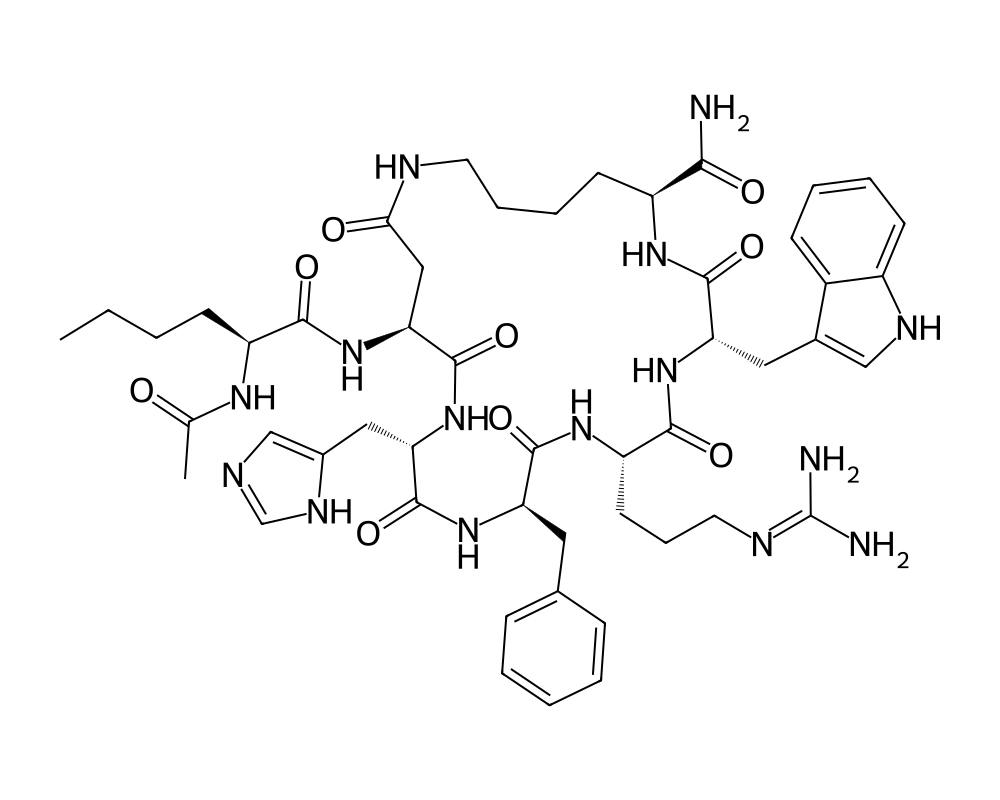
Research tool
Reconstitution calculator
Concentration
2.50mg/mL
Draw volume
0.10mL
Insulin units
10IU
Doses/vial
20
Overview
Melanotan II (MT-II) is a synthetic cyclic heptapeptide analogue of alpha-melanocyte-stimulating hormone (alpha-MSH). Originally developed at the University of Arizona in the early 1990s by a team led by Dr. Victor Hruby and Dr. Mac Hadley, MT-II was designed as a more potent and metabolically stable derivative of the naturally occurring melanocortin peptide alpha-MSH.
Contents
- Overview
- Mechanism of Action
- MC1R-Mediated Melanogenesis
- MC3R/MC4R Central Nervous System Effects
- MC4R and Energy Homeostasis
- Research Summary
- Melanogenesis and Photoprotection
- Sexual Function Research
- Appetite and Body Composition
- Anti-Inflammatory Properties
- Dosing in Published Research
- Safety and Side Effects
- Current Research Status
- Frequently Asked Questions
The peptide acts as a non-selective agonist at melanocortin receptors MC1R through MC5R, with particular affinity for MC1R, MC3R, MC4R, and MC5R subtypes. Its cyclic structure, achieved through a lactam bridge between the lysine and aspartic acid residues at positions 4 and 10, confers significantly enhanced resistance to enzymatic degradation compared to linear alpha-MSH analogues.
MT-II was initially investigated for its potential as a sunless tanning agent due to its ability to stimulate melanogenesis through MC1R activation. Subsequent research revealed additional pharmacological activities mediated through its interactions with multiple melanocortin receptor subtypes, including effects on sexual function, appetite regulation, and inflammatory modulation.
Mechanism of Action
Melanotan II exerts its biological effects primarily through activation of the melanocortin receptor family, a group of five G protein-coupled receptors (MC1R-MC5R) that signal predominantly through the cyclic adenosine monophosphate (cAMP) pathway via Gs protein coupling.
MC1R-Mediated Melanogenesis
Upon binding to MC1R on epidermal melanocytes, MT-II triggers adenylyl cyclase activation, elevating intracellular cAMP levels. This activates protein kinase A (PKA), which phosphorylates cAMP response element-binding protein (CREB). Phosphorylated CREB upregulates microphthalmia-associated transcription factor (MITF), the master regulator of melanogenesis. MITF in turn drives expression of key enzymes including tyrosinase, tyrosinase-related protein 1 (TRP-1), and dopachrome tautomerase (TRP-2), shifting melanin production toward eumelanin synthesis.
MC3R/MC4R Central Nervous System Effects
MT-II crosses the blood-brain barrier and activates hypothalamic MC3R and MC4R. Activation of MC4R in the paraventricular nucleus has been shown to mediate effects on erectile function through descending oxytocinergic pathways. This mechanism, distinct from peripheral vasodilatory approaches, involves central neural signaling via the spinal cord to autonomic sacral outflow pathways.
MC4R and Energy Homeostasis
The MC4R is a key integrator of energy balance in the hypothalamus. MT-II activation of MC4R on neurons expressing the anorexigenic pro-opiomelanocortin (POMC) system contributes to appetite suppression. This occurs through modulation of downstream signaling cascades involving brain-derived neurotrophic factor (BDNF) and the sympathetic nervous system.
Research Summary
Melanotan II has been the subject of numerous preclinical and clinical investigations spanning several decades. The body of published research provides insights into its pharmacological profile and potential applications.
Melanogenesis and Photoprotection
Dorr et al. (1996) conducted one of the earliest clinical studies, published in Archives of Dermatology, demonstrating that subcutaneous administration of MT-II produced significant increases in skin melanin density in human volunteers without UV exposure. A subsequent study by Barnetson et al. (2006), published in the Journal of Investigative Dermatology, confirmed that MT-II could induce eumelanin production and provide measurable photoprotection against UV-induced DNA damage in fair-skinned individuals. This describes a measured laboratory endpoint and should not be read as evidence that MT-II is a safe or appropriate means of tanning or sun protection, particularly in light of the pigmentary and melanocyte-related concerns described in the safety section below.
Sexual Function Research
Wessells et al. (1998) published in the Journal of Urology that MT-II induced penile erections in men with psychogenic erectile dysfunction. This discovery led to the development of bremelanotide (PT-141), a metabolite-derivative of MT-II, which was eventually approved by the FDA in 2019 for hypoactive sexual desire disorder in premenopausal women under the brand name Vyleesi.
Appetite and Body Composition
Fan et al. (1997) demonstrated in Nature that intracerebroventricular administration of MT-II dramatically reduced food intake in rodent models, establishing the melanocortin system as a critical pathway in energy homeostasis. Subsequent work by Greenfield et al. (2009), published in the New England Journal of Medicine, confirmed the relevance of the MC4R pathway to human obesity.
Anti-Inflammatory Properties
Getting et al. (2006) published findings in Arthritis & Rheumatism demonstrating that melanocortin peptides, including MT-II, possess anti-inflammatory properties through activation of MC3R on macrophages and other immune cells, reducing pro-inflammatory cytokine release including TNF-alpha and IL-6.
Dosing in Published Research
About this section
The information below reports dosing only as it appears in published clinical or preclinical research and official regulatory documents. It is provided as published-literature reference material. It is not dosing guidance, not medical advice, and not a recommendation to use or self-administer this compound.
Melanotan II is a synthetic analog of melanocyte-stimulating hormone. It is not an approved medicine and has no labeled dose. It was examined in a small pilot Phase 1 study in which single subcutaneous doses of roughly 0.01 to 0.03 mg per kilogram of body weight were given, with about 0.025 mg per kilogram identified as a tolerated single dose for further study. Side effects such as nausea and fatigue were noted at the higher end. These figures describe what was administered in that specific small study.
Research doses, not a protocol
These figures come from a small early-phase study, not an established or recommended regimen, and no long-term safety data exist. Melanotan II has been associated with changing or darkening moles and with nausea and blood-pressure effects; it is not an approved drug, and material sold for research use is not a regulated drug product.
Safety and Side Effects
Melanotan II is not an approved drug in any jurisdiction. It has no approved medical use, has not completed the safety evaluation required for approval, and is widely sold illegally as an unlicensed product; regulatory agencies including the FDA and the UK Medicines and Healthcare products Regulatory Agency have issued warnings against its sale and use. Material sold under this name is of uncertain identity, dose, and purity.
Because MT-II is a non-selective melanocortin receptor agonist that strongly stimulates melanocytes, darkening of existing moles and other pigmented lesions (nevi) has been reported. This raises a theoretical concern about melanocyte stimulation in people with pre-existing atypical nevi. No causal link to melanoma has been established in clinical data, but the absence of controlled long-term data is itself a limitation, and there are published dermatology case reports of new and changing melanocytic lesions in people using melanotan products. Anyone with numerous moles, atypical moles, or a personal or family history of skin cancer should regard this as a significant unresolved concern, and any new, changing, or atypical pigmented lesion warrants dermatological evaluation.
Commonly reported acute effects include nausea, which is often pronounced after dosing, facial flushing, decreased appetite, and spontaneous penile erections, the last following directly from the compound’s melanocortin activity. Prolonged erection (priapism) has been reported and is a medical emergency. Other reported effects include darkening of freckles and new freckle formation, and injection-site reactions. Long-term safety, including any effect on melanoma risk, has not been characterized in controlled human trials.
Current Research Status
Melanotan II is an investigational compound that was never approved for human use. Research interest in melanocortin pharmacology led instead to the selective MC4R agonist bremelanotide (PT-141), which was developed separately and is the only melanocortin peptide in this area to reach FDA approval. The research literature on MT-II itself is limited and largely dated, and the compound is not approved for tanning, sexual function, or any other use. It is distributed only through unregulated channels.
Frequently Asked Questions
What is Melanotan II?
Melanotan II is a synthetic cyclic heptapeptide that mimics alpha-melanocyte-stimulating hormone, which controls skin pigment. It is sometimes marketed as a tanning peptide but is not an approved drug, and regulators in several countries have warned against it.
How does Melanotan II work?
Melanotan II activates the melanocortin receptor family. Through MC1R it prompts skin cells to produce more of the pigment melanin, and through other melanocortin receptors it can also affect sexual function and appetite.
Is Melanotan II FDA-approved?
No. Melanotan II is an investigational compound that was never approved for human use in any jurisdiction. It is widely sold illegally as an unlicensed product, and agencies including the FDA and the UK regulator have issued warnings about it.
What does the research say about Melanotan II?
Melanotan II has been studied in preclinical and clinical research over several decades, including early work on melanogenesis and photoprotection (Dorr et al., 1996). Interest in melanocortin pharmacology led instead to the separate, selective MC4R agonist bremelanotide (PT-141), which reached FDA approval.
What are the safety concerns with Melanotan II?
Melanotan II has not completed the safety evaluation required for approval. Reported effects include nausea, spontaneous erections and darkening of moles and pigmentation. Because it is an unlicensed product, its quality and purity are also not assured.
Research Handling & Storage
Reconstitution (General Guidelines)
Lyophilized peptides are typically reconstituted using bacteriostatic water (0.9% benzyl alcohol). Standard reconstitution protocol:
- Remove the vial from storage and allow it to reach room temperature (20–25°C / 68–77°F) before opening. This typically takes 15–20 minutes.
- Clean the vial stopper with an alcohol prep pad and allow to air dry.
- Using a sterile syringe, slowly inject bacteriostatic water along the inside wall of the vial. Do not spray directly onto the lyophilized powder.
- Gently swirl the vial until the powder is fully dissolved. Do not shake vigorously as this may damage the peptide structure.
- The reconstituted solution should be clear and colorless. Discard if cloudy, discolored, or if particulate matter is visible.
- Label the vial with the reconstitution date, concentration, and your initials.
Common reconstitution volumes in research: 1ml or 2ml of bacteriostatic water per vial, depending on the desired concentration. For example, adding 2ml to a 5mg vial yields a concentration of 2.5mg/ml (2,500mcg/ml).
Storage
- Lyophilized (unreconstituted): Store at -20°C (-4°F) for long-term storage (stable 24+ months), or 2–8°C (36–46°F) refrigerated for short-term storage up to 6 months. Keep desiccated and protected from light.
- Reconstituted: Store at 2–8°C (36–46°F) refrigerated. Use within 4–6 weeks of reconstitution. Do not freeze reconstituted solutions as this may cause degradation.
- Shipping: Lyophilized peptides are generally stable at ambient temperature during transit for several days. Reconstituted solutions should be shipped on ice packs.
Handling Precautions
- Handle with appropriate personal protective equipment (PPE) including nitrile gloves, lab coat, and eye protection.
- Use aseptic/sterile technique when reconstituting and transferring solutions to prevent contamination.
- Avoid repeated freeze-thaw cycles which may denature the compound and reduce potency.
- Keep detailed laboratory records including reconstitution dates, lot numbers, concentrations, and storage conditions.
- Dispose of unused material and sharps in accordance with local regulations and institutional biosafety guidelines.
Stability & Shelf Life
Lyophilized (freeze-dried) peptides are highly stable when stored correctly. At -20°C (-4°F), most peptides retain >95% purity for 24 months or longer. Once reconstituted, the clock starts—proteins in solution are inherently less stable than in dry form. Factors that accelerate degradation include temperature fluctuations, exposure to light, repeated freeze-thaw cycles, bacterial contamination, and oxidation.
Purity & Quality Considerations
Research-grade compounds should be accompanied by a Certificate of Analysis (COA) confirming purity, typically verified by High-Performance Liquid Chromatography (HPLC) and Mass Spectrometry (MS). Look for purity levels of ≥98% for research applications. Third-party testing adds an additional layer of quality assurance. Always verify the source and documentation before using any research compound.
Research Supplies & Resources
Essential supplies and educational resources for peptide research. Links go to Amazon.com.
Lab Supplies
Recommended Reading
Lab Equipment
As an Amazon Associate, peptides.fyi earns from qualifying purchases. Learn more.
