
Synopsis
Compound overview
- Research only
- In clinical trials
- Approved outside US
- FDA-approved
What it is
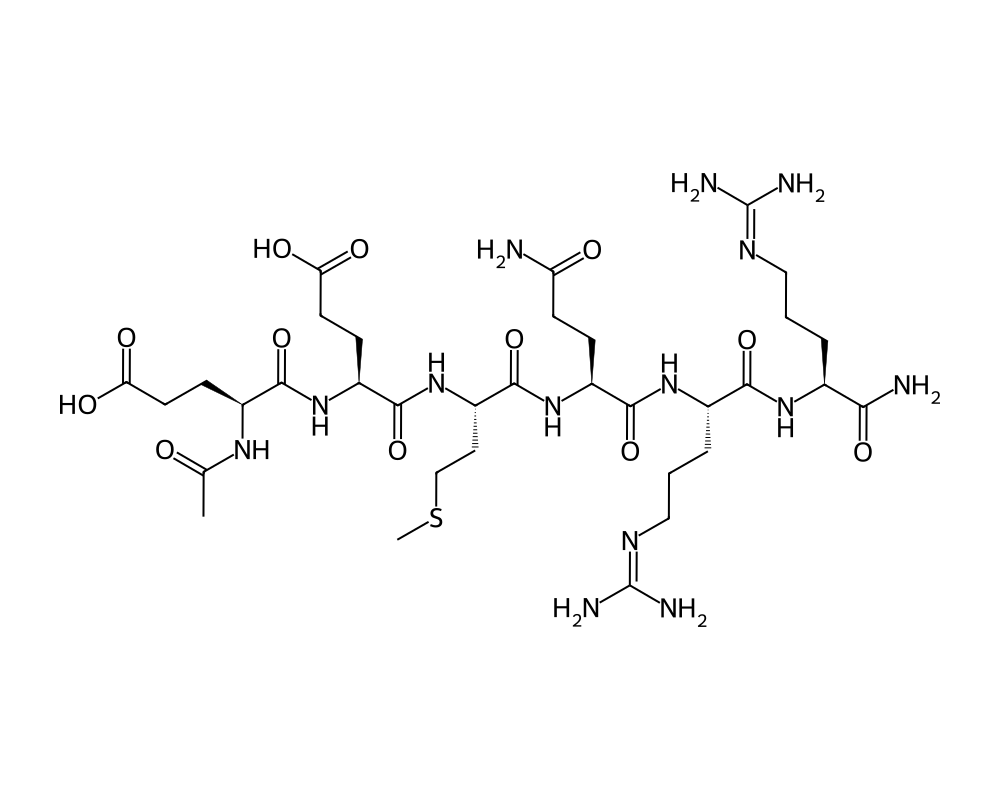
Argireline (acetyl hexapeptide-8) is a synthetic six-amino-acid peptide developed as a cosmetic ingredient. It is widely used in topical anti-wrinkle skincare and is not an approved drug.
What it does
How it is used and marketed:
- Used in topical "Botox-alternative" skincare
- Marketed to soften the look of expression lines
- Studied mainly for surface wrinkle appearance
- Applied to the skin, not injected
How it works
Argireline is designed to interfere with the release of signals that make facial muscles contract, with the aim of slightly relaxing expression lines. Its effect when applied topically is modest and debated.
Safety notes
Argireline has a long record as a topical cosmetic ingredient and is generally well tolerated on the skin. It is not intended for injection, and evidence for dramatic results is limited. Patch-testing is sensible for anyone with sensitive skin.
Where to buy Argireline
Standard lyophilized vial — reconstitute and measure doses yourself. The conventional research format.
Affiliate links — we may earn a commission at no extra cost to you.
Molecular Structure
Research tool
Reconstitution calculator
Concentration
2.50mg/mL
Draw volume
0.10mL
Insulin units
10IU
Doses/vial
20
Overview
Argireline, known by its International Nomenclature of Cosmetic Ingredients (INCI) name Acetyl Hexapeptide-3 (later updated to Acetyl Hexapeptide-8), is a synthetic hexapeptide developed by the Spanish biotechnology company Lipotec (now part of Lubrizol). It was introduced to the cosmetic market in the early 2000s as a topical alternative to botulinum toxin injections for the reduction of expression-related facial wrinkles.
Contents
- Overview
- Mechanism of Action
- SNARE Complex Interference
- Catecholamine Release Modulation
- Topical Penetration and Local Effect
- Research Summary
- In Vitro SNARE Complex Studies
- Clinical Wrinkle Reduction Studies
- Comparative Efficacy Analysis
- Combination Studies
- Dosing in Published Research
- Safety and Side Effects
- Current Research Status
- Frequently Asked Questions
The peptide is derived from the N-terminal end of SNAP-25 (Synaptosomal-Associated Protein of 25 kDa), one of three proteins that constitute the SNARE (Soluble N-ethylmaleimide-sensitive factor Attachment protein Receptor) complex essential for synaptic vesicle fusion and neurotransmitter release. By mimicking a portion of SNAP-25, Argireline competes for positions within the SNARE complex assembly, thereby attenuating neurotransmitter release at the neuromuscular junction.
Unlike botulinum toxin, which enzymatically cleaves SNARE proteins, Argireline acts through a competitive inhibition mechanism that is inherently milder, reversible, and suitable for topical cosmetic application. This distinction has made it one of the most commercially successful cosmetic peptides, incorporated into numerous anti-aging formulations worldwide.
Mechanism of Action
Argireline modulates the neuromuscular signaling process by interfering with the molecular machinery responsible for acetylcholine release at the neuromuscular junction. Its mechanism operates at the level of vesicular exocytosis.
SNARE Complex Interference
Normal neurotransmitter release requires the assembly of a ternary SNARE complex consisting of syntaxin-1 and SNAP-25 on the presynaptic membrane (t-SNAREs) and synaptobrevin/VAMP2 on the synaptic vesicle (v-SNARE). These three proteins coil together into a four-helix bundle that generates the mechanical force necessary to drive vesicle-membrane fusion. Argireline, being a fragment of the SNAP-25 N-terminal coiled-coil domain, competes with endogenous SNAP-25 for binding to syntaxin-1. The resulting incomplete complexes lack the full complement of alpha-helical zippers required for productive membrane fusion.
Catecholamine Release Modulation
Bhargava et al. documented that Argireline inhibits catecholamine release from chromaffin cells in a dose-dependent manner, confirming its ability to interfere with regulated exocytosis. The inhibition was shown to be specific to the SNARE-dependent fusion pathway, as constitutive secretion remained unaffected. This selectivity arises because constitutive secretion utilizes different SNARE isoforms not targeted by the SNAP-25 fragment.
Topical Penetration and Local Effect
For topical cosmetic applications, Argireline must penetrate the stratum corneum to reach the dermal-epidermal junction where motor nerve terminals innervate the arrector pili muscles and facial expression muscles. Studies by Lipotec demonstrated that the acetylated N-terminus enhances lipophilicity relative to the unmodified peptide, improving partitioning into the lipid-rich intercellular matrix of the stratum corneum. Once in the viable epidermis, Argireline acts on local nerve terminals to reduce the intensity of muscle contractions that contribute to dynamic wrinkle formation.
Research Summary
Argireline has been evaluated in both in vitro biochemical assays and clinical studies measuring its effects on wrinkle depth and skin appearance.
In Vitro SNARE Complex Studies
Bhargava et al. (2006), publishing in FEBS Letters, demonstrated that Acetyl Hexapeptide-3 inhibited SNARE complex formation in a cell-free system and reduced norepinephrine release from chromaffin cells by up to 40% at micromolar concentrations. The study confirmed the peptide’s mechanism involved competition with native SNAP-25 rather than proteolytic cleavage, distinguishing it mechanistically from botulinum toxins.
Clinical Wrinkle Reduction Studies
Blanes-Mira et al. (2002), publishing in the International Journal of Cosmetic Science, reported the original characterization of Argireline’s anti-wrinkle effects. In a placebo-controlled clinical study involving 10 female volunteers applying a 10% Argireline solution twice daily for 30 days, silicone replica analysis revealed an average wrinkle depth reduction of 30% in the periorbital area compared to baseline. The placebo group showed no significant change.
Comparative Efficacy Analysis
Wang et al. (2013), in a study published in the Journal of Cosmetic Dermatology, compared formulations containing Argireline at concentrations of 5% and 10% over a 28-day application period. The 10% concentration demonstrated statistically significant reductions in wrinkle parameters measured by profilometry, including a 17% decrease in maximum roughness (Rmax) and a 21.8% reduction in total wrinkle area. Lower concentrations showed trends toward improvement that did not reach statistical significance in all parameters.
Combination Studies
Lunetta et al. (2019), published in Clinical, Cosmetic and Investigational Dermatology, evaluated Argireline in combination with other cosmeceutical peptides including pentapeptide-18 (Leuphasyl) and dipeptide diaminobutyroyl benzylamide diacetate (Syn-Ake). The multi-peptide formulation showed enhanced wrinkle reduction compared to Argireline alone, supporting the concept that targeting multiple steps in the neuromuscular signaling cascade can produce additive or synergistic cosmetic benefits.
Dosing in Published Research
About this section
The information below reports dosing only as it appears in published clinical or preclinical research and official regulatory documents. It is provided as published-literature reference material. It is not dosing guidance, not medical advice, and not a recommendation to use or self-administer this compound.
Argireline is the trade name for acetyl hexapeptide-8, a synthetic peptide used as a topical ingredient in cosmetic anti-wrinkle products. In that context it is described by its concentration in a finished formulation; topical studies have evaluated concentrations up to roughly 10 percent, with preliminary and inconsistent results. Argireline is not administered as a systemic dose, and no clinical trial has established one. Specific injectable figures circulating in vendor material are therefore not reported here.
Topical use only; no systemic dose
Argireline is a topical cosmetic peptide; it has no established systemic or injectable dose, and any such figures circulating online are unverified. It is not an approved drug product for systemic use.
Safety and Side Effects
Argireline is used as a topical cosmetic ingredient, and at the low concentrations found in skincare formulations it is generally well tolerated; reported effects are limited mainly to mild, transient skin irritation, redness, or dryness in some users. It is not formulated or evaluated as an injectable drug, and it should not be assumed safe for routes of administration other than topical application to intact skin. Because it is a cosmetic ingredient rather than an approved drug, its long-term effects have not been studied to drug-approval standards. Its topically applied effect on the appearance of expression lines is modest and reversible. Patch testing is reasonable for individuals with sensitive skin.
Current Research Status
Argireline is a cosmetic peptide ingredient, not an approved drug, and it carries no approved therapeutic claim. The research supporting it consists mainly of small cosmetic-efficacy studies measuring changes in the appearance of expression lines; it has not been evaluated through drug clinical trials. It is widely and legally used in topical skincare products, where it is regulated as a cosmetic ingredient rather than as a medicine.
Frequently Asked Questions
What is Argireline?
Argireline (acetyl hexapeptide-8, originally acetyl hexapeptide-3) is a synthetic six-amino-acid peptide developed as a cosmetic ingredient. It is widely used in topical anti-wrinkle skincare and is not an approved drug.
How does Argireline work?
Argireline is designed to interfere with the SNARE complex, the molecular machinery that releases the signal (acetylcholine) telling facial muscles to contract. By dampening that signalling, it is intended to soften the appearance of expression lines.
Is Argireline an approved drug?
No. Argireline is a cosmetic peptide ingredient, not an approved drug, and it carries no approved therapeutic claim. It is applied to the skin in skincare products, not injected.
What does the research say about Argireline?
The research consists mainly of in vitro biochemical assays and small cosmetic-efficacy studies of wrinkle appearance; for example, Bhargava and colleagues (2006) showed it inhibited SNARE complex formation in the laboratory. It has not been evaluated through drug clinical trials.
What are the safety concerns with Argireline?
As a topical cosmetic ingredient at the low concentrations used in skincare, Argireline is generally well tolerated, with reported effects limited mainly to mild, transient skin irritation, redness or dryness. It is not formulated or evaluated as an injectable.
Research Handling & Storage
Reconstitution (General Guidelines)
Lyophilized peptides are typically reconstituted using bacteriostatic water (0.9% benzyl alcohol). Standard reconstitution protocol:
- Remove the vial from storage and allow it to reach room temperature (20–25°C / 68–77°F) before opening. This typically takes 15–20 minutes.
- Clean the vial stopper with an alcohol prep pad and allow to air dry.
- Using a sterile syringe, slowly inject bacteriostatic water along the inside wall of the vial. Do not spray directly onto the lyophilized powder.
- Gently swirl the vial until the powder is fully dissolved. Do not shake vigorously as this may damage the peptide structure.
- The reconstituted solution should be clear and colorless. Discard if cloudy, discolored, or if particulate matter is visible.
- Label the vial with the reconstitution date, concentration, and your initials.
Common reconstitution volumes in research: 1ml or 2ml of bacteriostatic water per vial, depending on the desired concentration. For example, adding 2ml to a 5mg vial yields a concentration of 2.5mg/ml (2,500mcg/ml).
Storage
- Lyophilized (unreconstituted): Store at -20°C (-4°F) for long-term storage (stable 24+ months), or 2–8°C (36–46°F) refrigerated for short-term storage up to 6 months. Keep desiccated and protected from light.
- Reconstituted: Store at 2–8°C (36–46°F) refrigerated. Use within 4–6 weeks of reconstitution. Do not freeze reconstituted solutions as this may cause degradation.
- Shipping: Lyophilized peptides are generally stable at ambient temperature during transit for several days. Reconstituted solutions should be shipped on ice packs.
Handling Precautions
- Handle with appropriate personal protective equipment (PPE) including nitrile gloves, lab coat, and eye protection.
- Use aseptic/sterile technique when reconstituting and transferring solutions to prevent contamination.
- Avoid repeated freeze-thaw cycles which may denature the compound and reduce potency.
- Keep detailed laboratory records including reconstitution dates, lot numbers, concentrations, and storage conditions.
- Dispose of unused material and sharps in accordance with local regulations and institutional biosafety guidelines.
Stability & Shelf Life
Lyophilized (freeze-dried) peptides are highly stable when stored correctly. At -20°C (-4°F), most peptides retain >95% purity for 24 months or longer. Once reconstituted, the clock starts—proteins in solution are inherently less stable than in dry form. Factors that accelerate degradation include temperature fluctuations, exposure to light, repeated freeze-thaw cycles, bacterial contamination, and oxidation.
Purity & Quality Considerations
Research-grade compounds should be accompanied by a Certificate of Analysis (COA) confirming purity, typically verified by High-Performance Liquid Chromatography (HPLC) and Mass Spectrometry (MS). Look for purity levels of ≥98% for research applications. Third-party testing adds an additional layer of quality assurance. Always verify the source and documentation before using any research compound.
Research Supplies & Resources
Essential supplies and educational resources for peptide research. Links go to Amazon.com.
Lab Supplies
Recommended Reading
Lab Equipment
As an Amazon Associate, peptides.fyi earns from qualifying purchases. Learn more.
