
Synopsis
Compound overview
- Research only
- In clinical trials
- Approved outside US
- FDA-approved
What it is
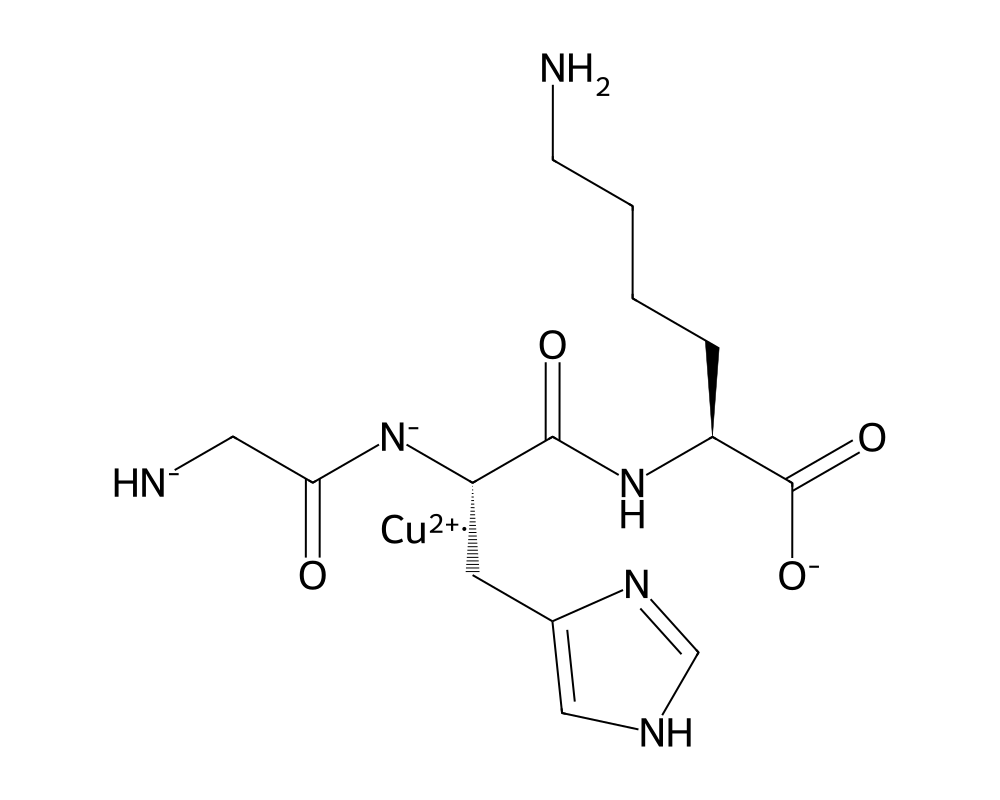
GHK-Cu is a copper peptide — a small three-amino-acid chain (glycine-histidine-lysine) bound to a copper ion. It occurs naturally in human plasma and is a long-standing ingredient in cosmetic skincare. As an injectable research chemical it is not an approved drug.
What it does
Documented and studied uses include:
- Widely used in topical anti-ageing skincare
- Studied for skin repair and collagen support
- Researched for wound healing
- Influences a broad range of genes in lab studies
How it works
GHK-Cu delivers copper, a mineral involved in skin repair, and research suggests the peptide itself influences gene activity tied to collagen production, tissue remodelling and antioxidant defence.
Safety notes
GHK-Cu is well established as a topical cosmetic ingredient, but injectable research-grade use has no completed human trials behind it. Copper can be harmful in excess, and research-grade purity varies. Injected use should be considered experimental.
Where to buy GHK-Cu
Standard lyophilized vial — reconstitute and measure doses yourself. The conventional research format.
Affiliate links — we may earn a commission at no extra cost to you.
Molecular Structure
Research tool
Reconstitution calculator
Concentration
2.50mg/mL
Draw volume
0.10mL
Insulin units
10IU
Doses/vial
20
Overview
GHK-Cu (glycyl-L-histidyl-L-lysine:copper(II)) is a naturally occurring tripeptide-copper complex first identified in human blood plasma by Dr. Loren Pickart in 1973. Pickart discovered that a small peptide present in the albumin fraction of blood from young donors could stimulate aged liver cells to synthesize proteins at rates similar to those observed in young tissue. Subsequent structural analysis revealed this factor to be the tripeptide Gly-His-Lys with a high-affinity copper(II) binding site.
Contents
- Overview
- Mechanism of Action
- Copper Delivery and Enzyme Activation
- Gene Expression Modulation
- Collagen and Extracellular Matrix Remodeling
- Research Summary
- Wound Healing and Tissue Repair
- Skin Remodeling and Anti-Aging
- Anti-Inflammatory and Antioxidant Effects
- Hair Growth and Follicle Biology
- Neuroprotective Properties
- Dosing in Published Research
- Safety and Side Effects
- Current Research Status
- Frequently Asked Questions
GHK-Cu is present in human plasma at approximately 200 ng/mL in young adults, with levels declining significantly with age, falling to approximately 80 ng/mL by age 60. This age-dependent decline has led researchers to hypothesize that reduced GHK-Cu levels may contribute to diminished tissue repair and regenerative capacity associated with aging. The peptide has since been extensively studied for its roles in wound healing, collagen synthesis, anti-inflammatory signaling, antioxidant defense, and gene expression modulation.
Beyond its endogenous biological roles, GHK-Cu has found widespread commercial application in the cosmetic and skincare industry, where it is marketed as an ingredient in anti-aging serums, creams, and treatments. Its established safety profile and multifaceted tissue repair properties have also generated interest in regenerative medicine and dermatological research.
Mechanism of Action
GHK-Cu operates through multiple complementary mechanisms, many of which are mediated by its ability to deliver bioavailable copper to cells and to modulate gene expression on a broad scale.
Copper Delivery and Enzyme Activation
The copper(II) ion chelated by GHK is essential for the catalytic activity of several enzymes critical to tissue repair and remodeling. These include lysyl oxidase (required for collagen and elastin crosslinking), superoxide dismutase (a key antioxidant enzyme), cytochrome c oxidase (mitochondrial electron transport), and tyrosinase (melanin synthesis). GHK-Cu acts as a physiological copper shuttle, delivering the metal ion to cells in a bioavailable, non-toxic form. Pickart et al. (2012), in a review published in Oxidative Medicine and Cellular Longevity, detailed how this copper delivery system underpins many of the peptide’s regenerative effects.
Gene Expression Modulation
Microarray studies by Pickart et al. (2015), published in Gene, revealed that GHK-Cu modulates the expression of over 4,000 human genes, representing approximately 6% of the human genome. The peptide upregulates genes associated with tissue repair, collagen synthesis, neural cell survival, and antioxidant defense, while simultaneously downregulating genes involved in inflammation, fibrinogen production, and tissue destruction. This broad transcriptomic reprogramming suggests that GHK-Cu acts as a master regulator of tissue remodeling rather than targeting a single pathway.
Collagen and Extracellular Matrix Remodeling
GHK-Cu stimulates the synthesis of collagen types I, III, and V in dermal fibroblasts, along with decorin, proteoglycans, and glycosaminoglycans that comprise the extracellular matrix. Simultaneously, it modulates matrix metalloproteinase (MMP) activity, promoting the controlled breakdown of damaged matrix components while supporting the deposition of new, properly organized collagen fibrils. This balanced remodeling activity is crucial for wound healing without excessive scar formation.
Research Summary
Wound Healing and Tissue Repair
Canapp et al. (2003), publishing in Veterinary Surgery, conducted a controlled study on the effects of GHK-Cu on wound healing in dogs. Ischemic open wounds treated with GHK-Cu-containing dressings showed significantly accelerated healing rates, with increased granulation tissue formation, enhanced angiogenesis, and more rapid epithelialization compared to control wounds. Histological analysis revealed denser collagen deposition with improved fiber organization in GHK-Cu-treated wounds, consistent with higher quality tissue repair rather than mere acceleration of closure.
Skin Remodeling and Anti-Aging
Pickart et al. (2012) comprehensively reviewed the dermatological applications of GHK-Cu. Clinical studies on topical application demonstrated measurable improvements in skin thickness, elasticity, and firmness after 12 weeks of use. Photographic analysis and skin profilometry revealed reduction in fine lines and wrinkles, while histological examination showed increased collagen density in the papillary dermis. The peptide also improved skin barrier function by increasing the production of integrin receptors and promoting keratinocyte proliferation and differentiation.
Anti-Inflammatory and Antioxidant Effects
GHK-Cu demonstrates potent anti-inflammatory activity through multiple mechanisms. It suppresses the production of pro-inflammatory cytokines including interleukin-6 (IL-6) and tumor necrosis factor-alpha (TNF-alpha) while upregulating anti-inflammatory mediators such as interleukin-10 (IL-10). Pickart et al. (2015) reported that GHK-Cu treatment in cell culture models reduced markers of oxidative stress, including lipid peroxidation and iron-catalyzed free radical damage, by activating endogenous antioxidant pathways including the Nrf2 transcription factor system.
Hair Growth and Follicle Biology
Research has demonstrated that GHK-Cu influences hair follicle biology. Studies have shown that the peptide increases follicle size, stimulates hair growth, and may counteract the miniaturization of hair follicles associated with androgenetic alopecia. The mechanism involves upregulation of vascular endothelial growth factor (VEGF) in dermal papilla cells, increased proliferation of follicular keratinocytes, and modulation of the Wnt/beta-catenin signaling pathway, which is essential for hair follicle morphogenesis and cycling. These findings have led to the inclusion of GHK-Cu in several hair growth products and formulations.
Neuroprotective Properties
Emerging research suggests that GHK-Cu may possess neuroprotective properties relevant to neurodegenerative conditions. Gene expression studies have shown that the peptide upregulates neural cell survival genes and downregulates genes associated with neuroinflammation. Additionally, GHK-Cu’s ability to modulate copper homeostasis is relevant to conditions such as Alzheimer’s disease and Parkinson’s disease, where aberrant copper metabolism contributes to oxidative damage and protein aggregation in neural tissue.
Dosing in Published Research
About this section
The information below reports dosing only as it appears in published clinical or preclinical research and official regulatory documents. It is provided as published-literature reference material. It is not dosing guidance, not medical advice, and not a recommendation to use or self-administer this compound.
GHK-Cu (copper tripeptide-1) is used mainly as a topical ingredient in cosmetic skincare products, where it is described by its concentration in a formulation rather than by an administered dose. No controlled human clinical trial has established a systemic or injectable dose for GHK-Cu. Specific injectable figures circulating in vendor material are not derived from human research and are therefore not reported here.
Topical use only; no systemic dose
GHK-Cu is encountered as a topical cosmetic ingredient; no controlled human trial has established a safe systemic or injectable dose, so any such figures circulating online are unverified. Injectable material sold under this name is not an approved drug product and is for laboratory research use only.
Safety and Side Effects
GHK-Cu, the copper tripeptide, is widely used as a topical cosmetic ingredient, and at the concentrations used in skincare it is generally well tolerated; reported effects are limited mainly to mild skin irritation or redness in some users and occasional contact sensitivity. Its safety as a topical agent does not extend to injection: injectable use of GHK-Cu has not been evaluated for safety in controlled trials, and introducing copper-containing compounds systemically raises real questions, because copper is tightly regulated in the body and excess copper is harmful. As with other agents that promote tissue remodeling and angiogenesis, systemic pro-regenerative activity has not been studied for any effect on abnormal tissue growth. Injectable research-chemical material is also of uncertain identity, sterility, and purity.
Current Research Status
GHK-Cu is used legally as a cosmetic ingredient in topical skincare products, where it is regulated as a cosmetic rather than as a drug. It is not an approved drug for any indication. The research on GHK-Cu spans cell-culture and wound-healing studies and small cosmetic-efficacy studies; injectable or systemic use is not supported by approved clinical evidence and should be regarded as investigational.
Further reading: GHK-Cu is one of four components in the KLOW peptide blend, examined alongside BPC-157, TB-500, and KPV.
Frequently Asked Questions
What is GHK-Cu?
GHK-Cu is a copper peptide, a three-amino-acid chain (glycine-histidine-lysine) bound to a copper ion. It occurs naturally in human plasma and is a long-standing ingredient in cosmetic skincare. As an injectable research chemical it is not an approved drug.
How does GHK-Cu work?
GHK-Cu acts partly by delivering bioavailable copper to cells, which supports copper-dependent enzymes, and partly by influencing the expression of a broad range of genes involved in tissue remodeling and collagen support, as observed in laboratory studies.
Is GHK-Cu FDA-approved?
GHK-Cu is used legally as a cosmetic ingredient in topical skincare, where it is regulated as a cosmetic rather than a drug. It is not an approved drug for any indication, and injectable use is not an approved application.
What does the research say about GHK-Cu?
Research spans cell-culture work, animal wound-healing studies and small cosmetic-efficacy studies. For example, a controlled study in dogs (Canapp et al., 2003) reported accelerated healing of ischemic wounds treated with GHK-Cu dressings. Topical cosmetic evidence is the most developed.
What are the safety concerns with GHK-Cu?
As a topical cosmetic ingredient at skincare concentrations, GHK-Cu is generally well tolerated, with reported effects limited mainly to mild skin irritation, redness or occasional contact sensitivity. Its safety as an injectable has not been formally established.
Research Handling & Storage
Reconstitution (General Guidelines)
Lyophilized peptides are typically reconstituted using bacteriostatic water (0.9% benzyl alcohol). Standard reconstitution protocol:
- Remove the vial from storage and allow it to reach room temperature (20–25°C / 68–77°F) before opening. This typically takes 15–20 minutes.
- Clean the vial stopper with an alcohol prep pad and allow to air dry.
- Using a sterile syringe, slowly inject bacteriostatic water along the inside wall of the vial. Do not spray directly onto the lyophilized powder.
- Gently swirl the vial until the powder is fully dissolved. Do not shake vigorously as this may damage the peptide structure.
- The reconstituted solution should be clear and colorless. Discard if cloudy, discolored, or if particulate matter is visible.
- Label the vial with the reconstitution date, concentration, and your initials.
Common reconstitution volumes in research: 1ml or 2ml of bacteriostatic water per vial, depending on the desired concentration. For example, adding 2ml to a 5mg vial yields a concentration of 2.5mg/ml (2,500mcg/ml).
Storage
- Lyophilized (unreconstituted): Store at -20°C (-4°F) for long-term storage (stable 24+ months), or 2–8°C (36–46°F) refrigerated for short-term storage up to 6 months. Keep desiccated and protected from light.
- Reconstituted: Store at 2–8°C (36–46°F) refrigerated. Use within 4–6 weeks of reconstitution. Do not freeze reconstituted solutions as this may cause degradation.
- Shipping: Lyophilized peptides are generally stable at ambient temperature during transit for several days. Reconstituted solutions should be shipped on ice packs.
Handling Precautions
- Handle with appropriate personal protective equipment (PPE) including nitrile gloves, lab coat, and eye protection.
- Use aseptic/sterile technique when reconstituting and transferring solutions to prevent contamination.
- Avoid repeated freeze-thaw cycles which may denature the compound and reduce potency.
- Keep detailed laboratory records including reconstitution dates, lot numbers, concentrations, and storage conditions.
- Dispose of unused material and sharps in accordance with local regulations and institutional biosafety guidelines.
Stability & Shelf Life
Lyophilized (freeze-dried) peptides are highly stable when stored correctly. At -20°C (-4°F), most peptides retain >95% purity for 24 months or longer. Once reconstituted, the clock starts—proteins in solution are inherently less stable than in dry form. Factors that accelerate degradation include temperature fluctuations, exposure to light, repeated freeze-thaw cycles, bacterial contamination, and oxidation.
Purity & Quality Considerations
Research-grade compounds should be accompanied by a Certificate of Analysis (COA) confirming purity, typically verified by High-Performance Liquid Chromatography (HPLC) and Mass Spectrometry (MS). Look for purity levels of ≥98% for research applications. Third-party testing adds an additional layer of quality assurance. Always verify the source and documentation before using any research compound.
Research Supplies & Resources
Essential supplies and educational resources for peptide research. Links go to Amazon.com.
Lab Supplies
Recommended Reading
Lab Equipment
As an Amazon Associate, peptides.fyi earns from qualifying purchases. Learn more.
