
Synopsis
Compound overview
- Research only
- In clinical trials
- Approved outside US
- FDA-approved
What it is
A molecule your body already makes and keeps in every cell — the most abundant antioxidant working inside human cells. Built from three amino acids, with its largest store in the liver. The cell’s own protection-and-cleanup system, not a foreign chemical.
What it does
Defends cells from everyday wear and tear. Its three main jobs:
- Neutralizes free radicals before they damage cells
- Helps the liver clear toxins and drug byproducts
- Keeps vitamins C and E in their active form
How it works
A sulfur-rich “thiol” group donates electrons to neutralize damaging molecules, gets used up, then is recycled back to fresh form by a dedicated enzyme — a continuous loop. It also tags toxins so the kidneys can flush them out.
Safety notes
One of the body’s own molecules, generally low-risk at typical doses with good short-term tolerability reported. Honest caveats: limited long-term and IV safety data, and purity varies by supplier. Research reference only — not medical advice.
Where to buy Glutathione
Pre-measured, dial-adjustable dosing — no reconstitution or measuring. The simplest research format to work with.
Standard lyophilized vial — reconstitute and measure doses yourself. The conventional research format.
Affiliate links — we may earn a commission at no extra cost to you.
Molecular Structure
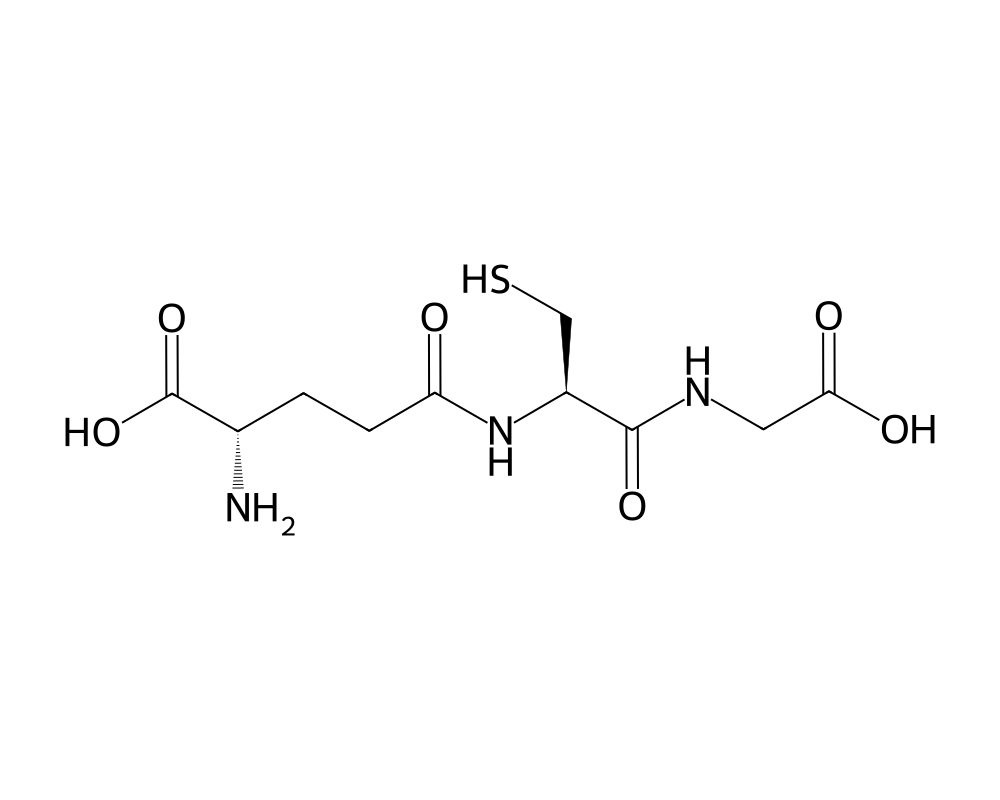
Research tool
Reconstitution calculator
Concentration
2.50mg/mL
Draw volume
0.10mL
Insulin units
10IU
Doses/vial
20
Overview
Glutathione (GSH) is a tripeptide composed of three amino acids in an unusual configuration. The bond between glutamate and cysteine forms through the gamma-carboxyl group of glutamate rather than the standard alpha-carboxyl, producing a peptide that is resistant to nearly all peptidases. That structural feature is the basis for the molecule’s long intracellular half-life. The cysteine residue carries a reactive thiol group that is the chemical heart of glutathione’s function as an antioxidant and conjugating substrate.
Contents
- Overview
- Mechanism of Action
- Direct ROS Scavenging
- Enzymatic Detoxification
- Heavy Metal Chelation
- Protein S-Glutathionylation
- Research Summary
- Hepatic Detoxification
- Parkinson's Disease and Neurodegeneration
- Bioavailability Considerations
- Skin Pigmentation
- Research Status
- Dosing in Published Research
- Frequently Asked Questions
Glutathione is the most abundant low-molecular-weight thiol in mammalian cells, present at millimolar concentrations in the cytosol of most tissues. The intracellular pool is dominated by the reduced form (GSH); the oxidized disulfide form (GSSG) is continuously recycled by glutathione reductase using NADPH as the electron donor. The GSH-to-GSSG ratio is a widely used measure of cellular redox state.
The tripeptide functions as a substrate for several enzyme families that handle oxidative and xenobiotic stress, including glutathione peroxidases (which reduce hydrogen peroxide and lipid peroxides), glutathione S-transferases (which conjugate electrophilic xenobiotics for biliary or urinary excretion), and thiol-disulfide oxidoreductases. Cellular glutathione depletion has been documented in hepatic injury, neurodegeneration, and several oxidative-stress-driven pathologies.
Mechanism of Action
Direct ROS Scavenging
The cysteine thiol of glutathione donates a hydrogen atom to reactive oxygen species, producing the thiyl radical (GS), which dimerizes with a second molecule to form oxidized glutathione (GSSG). This nonenzymatic chemistry contributes to the buffering of acute oxidative stress.
Enzymatic Detoxification
Glutathione peroxidases (GPx 1-8) catalyze reduction of hydrogen peroxide and organic peroxides using GSH as the reducing substrate. Glutathione S-transferases (GSTs) catalyze conjugation of GSH to electrophilic centers on xenobiotic molecules, producing more polar, excretable derivatives. Both enzyme families are central to the hepatic Phase II detoxification pathway described in classical pharmacology.
Heavy Metal Chelation
The cysteine thiol forms strong coordination bonds with soft Lewis acids including mercury, cadmium, copper, and arsenic. Glutathione mediates a substantial portion of cellular heavy metal sequestration and biliary excretion.
Protein S-Glutathionylation
Glutathione forms reversible mixed disulfides with protein cysteine residues, a post-translational modification termed S-glutathionylation. This modification serves as a redox-sensitive signaling mechanism distinct from the molecule’s bulk antioxidant role.
Research Summary
Hepatic Detoxification
Meister (1988, Annual Review of Biochemistry) reviewed the central role of glutathione in hepatic xenobiotic handling, work that has remained foundational. Acetaminophen overdose, the most common cause of acute liver failure, depletes hepatic glutathione, and the clinical antidote N-acetylcysteine (NAC) acts by providing cysteine for resynthesis of GSH.
Parkinson’s Disease and Neurodegeneration
Sechi et al. (1996, Progress in Neuro-Psychopharmacology and Biological Psychiatry) reported clinical improvements in Parkinson’s disease patients receiving intravenous glutathione. Allen et al. (2011, Integrative Medicine) reviewed subsequent IV glutathione work, noting variable methodological quality and a need for larger controlled trials. Pizzorno (2014) provides a frequently cited review of the broader glutathione clinical literature.
Bioavailability Considerations
Oral glutathione has poor bioavailability, the tripeptide is hydrolyzed in the gut and absorbed predominantly as its constituent amino acids, which are then resynthesized into GSH within cells. This has driven interest in cysteine precursors (NAC, gamma-glutamylcysteine), liposomal glutathione formulations, and parenteral routes.
Skin Pigmentation
Glutathione’s apparent effect on melanin production has driven a consumer market for oral, topical, and IV glutathione as a skin-lightening agent, particularly in parts of Asia. The peer-reviewed evidence is limited and the FDA has issued warnings about injectable glutathione products marketed for cosmetic skin lightening.
Research Status
Glutathione is an endogenous tripeptide and is well established biochemically. As an exogenous therapeutic, the published clinical literature is concentrated in Parkinson’s disease, hepatic injury (where NAC is the standard adjunct), and oxidative-stress-related conditions. Direct IV glutathione for research purposes carries the sterility and infection considerations of any injectable preparation. Skin-lightening marketing claims are not supported by FDA-approved indications.
Further reading: Glutathione: Antioxidant Research and Delivery Formats reviews the antioxidant literature and how delivery format affects bioavailability.
Dosing in Published Research
About this section
The information below reports dosing only as it appears in published clinical or preclinical research and official regulatory documents. It is provided as published-literature reference material. It is not dosing guidance, not medical advice, and not a recommendation to use or self-administer this compound.
Glutathione is an antioxidant molecule produced naturally by the body. It is also sold as a dietary supplement and is used in some unapproved intravenous regimens, but it is not an FDA-approved drug for general use, so it has no labeled therapeutic dose. Doses that appear in the research literature include oral supplementation studies using roughly 250 to 1,000 mg per day over several months, and a small intravenous pilot study in Parkinson disease that used about 1,400 mg three times weekly. These figures describe what was administered in those specific studies.
Research doses, not a protocol
These are research doses from small or preliminary studies, not an established or recommended regimen. Oral glutathione is poorly absorbed, and intravenous glutathione is not an FDA-approved therapy; material sold for research use is not a regulated drug product.
Frequently Asked Questions
What is glutathione?
Glutathione (GSH) is a tripeptide antioxidant the body makes in every cell, built from three amino acids. It is the most abundant antioxidant inside human cells, with its largest store in the liver.
How does glutathione work?
Glutathione’s cysteine thiol group donates hydrogen atoms to neutralize reactive oxygen species, and it supports the liver in clearing toxins and drug byproducts. It also helps keep vitamins C and E in their active forms.
Is glutathione FDA-approved?
Glutathione is an endogenous molecule that is well established biochemically, but it is not an FDA-approved drug for general therapeutic use. As an exogenous treatment it remains under clinical investigation.
What does the research say about glutathione?
Its role in liver detoxification is foundational and well documented; the antidote N-acetylcysteine works by restoring glutathione in acetaminophen overdose. Direct clinical research on supplemental glutathione is concentrated in areas such as Parkinson’s disease and oxidative-stress conditions, with mixed results.
What are the safety concerns with glutathione?
As a molecule the body produces itself, endogenous glutathione is well tolerated. Evidence on supplemental or intravenous glutathione is more limited, and the long-term safety of exogenous administration outside studied contexts is not well established.
Research Handling & Storage
Reconstitution (General Guidelines)
Lyophilized peptides are typically reconstituted using bacteriostatic water (0.9% benzyl alcohol). Standard reconstitution protocol:
- Remove the vial from storage and allow it to reach room temperature (20–25°C / 68–77°F) before opening. This typically takes 15–20 minutes.
- Clean the vial stopper with an alcohol prep pad and allow to air dry.
- Using a sterile syringe, slowly inject bacteriostatic water along the inside wall of the vial. Do not spray directly onto the lyophilized powder.
- Gently swirl the vial until the powder is fully dissolved. Do not shake vigorously as this may damage the peptide structure.
- The reconstituted solution should be clear and colorless. Discard if cloudy, discolored, or if particulate matter is visible.
- Label the vial with the reconstitution date, concentration, and your initials.
Common reconstitution volumes in research: 1ml or 2ml of bacteriostatic water per vial, depending on the desired concentration. For example, adding 2ml to a 5mg vial yields a concentration of 2.5mg/ml (2,500mcg/ml).
Storage
- Lyophilized (unreconstituted): Store at -20°C (-4°F) for long-term storage (stable 24+ months), or 2–8°C (36–46°F) refrigerated for short-term storage up to 6 months. Keep desiccated and protected from light.
- Reconstituted: Store at 2–8°C (36–46°F) refrigerated. Use within 4–6 weeks of reconstitution. Do not freeze reconstituted solutions as this may cause degradation.
- Shipping: Lyophilized peptides are generally stable at ambient temperature during transit for several days. Reconstituted solutions should be shipped on ice packs.
Handling Precautions
- Handle with appropriate personal protective equipment (PPE) including nitrile gloves, lab coat, and eye protection.
- Use aseptic/sterile technique when reconstituting and transferring solutions to prevent contamination.
- Avoid repeated freeze-thaw cycles which may denature the compound and reduce potency.
- Keep detailed laboratory records including reconstitution dates, lot numbers, concentrations, and storage conditions.
- Dispose of unused material and sharps in accordance with local regulations and institutional biosafety guidelines.
Stability & Shelf Life
Lyophilized (freeze-dried) peptides are highly stable when stored correctly. At -20°C (-4°F), most peptides retain >95% purity for 24 months or longer. Once reconstituted, the clock starts—proteins in solution are inherently less stable than in dry form. Factors that accelerate degradation include temperature fluctuations, exposure to light, repeated freeze-thaw cycles, bacterial contamination, and oxidation.
Purity & Quality Considerations
Research-grade compounds should be accompanied by a Certificate of Analysis (COA) confirming purity, typically verified by High-Performance Liquid Chromatography (HPLC) and Mass Spectrometry (MS). Look for purity levels of ≥98% for research applications. Third-party testing adds an additional layer of quality assurance. Always verify the source and documentation before using any research compound.
Research Supplies & Resources
Essential supplies and educational resources for peptide research. Links go to Amazon.com.
Lab Supplies
Recommended Reading
Lab Equipment
As an Amazon Associate, peptides.fyi earns from qualifying purchases. Learn more.
